
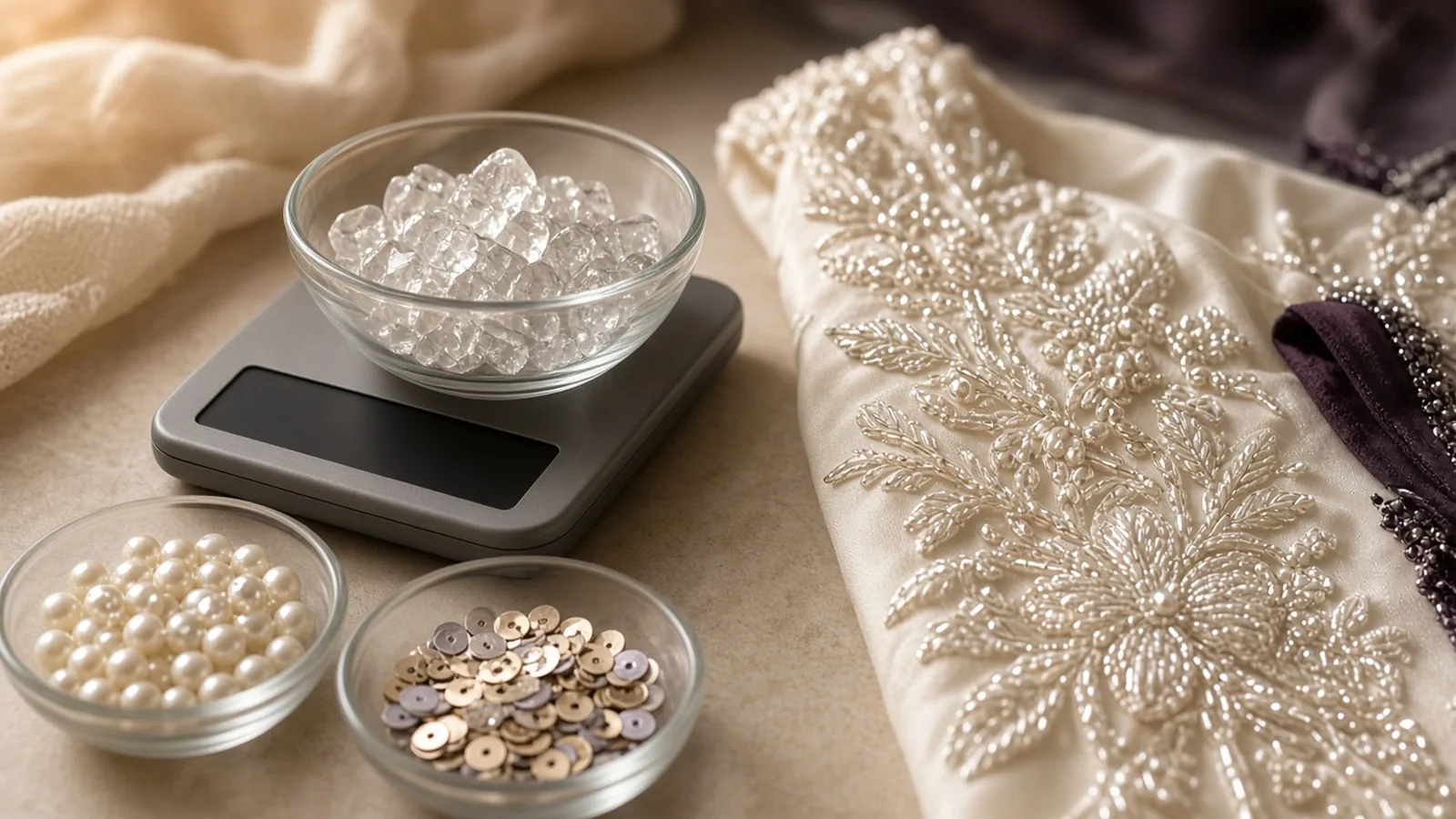
Embellishment is hard to see leaving. Fabric goes out in metres that anyone can measure. Beads go out in a handful, sit in open dishes on a frame for days, and end up on the garment, in a jar, or on the floor. A few grams here and there never shows until you count the stock or look at the margin on a heavily worked piece.
You do not need anything clever to control this. You need the right unit, a small scale, and the habit of weighing out and weighing back.
Grams or pieces: choose by size
The rule of thumb: count by the unit you can check quickly and accurately. Beads and sequins by the gram, crystals by the piece.
| Material | Count in | Why |
|---|---|---|
| Seed and bugle beads | Grams | Too small and too many to count. Beads are usually sold by weight, so stock and purchases match. |
| Loose sequins | Grams | Commonly sold by weight, with the piece count varying per pack. |
| Flat-back crystals | Pieces | Larger, costly per stone, and often sold by the gross, about 144 pieces. An SS20 stone is about 4.8 mm wide, big enough to count. |
| Pearls, sew-on stones, motifs | Pieces | Each one is a visible item with a real price. |
| Sequin strings, trims | Metres | Measured off the reel. |
Whatever you pick, keep one unit per material from purchase to garment. Bought in grams, stored in jars and issued "by the spoon" means you are holding three different numbers. An embroidery writer who repacks her own stock rejects measuring by volume for this reason: there is too much variation.
How many beads are in a gram?
Published charts give a starting point. One supplier's average figures run like this:
- 8/0 round: about 38 to 43 per gram
- 11/0 round: about 106 to 109 per gram
- 11/0 cylinder: about 193 per gram
- 15/0 round: about 250 to 287 per gram
The same page warns that amounts vary with colour, finish and coating, and the ranges above show that makers differ too. So use the chart for rough planning and measure your own beads for costing.
Make your own rate
- Put an empty dish on the scale and zero it.
- Count out a few hundred beads.
- Weigh them, then divide count by weight.
- Write the rate on the jar, with the lot and the date.
Take a big sample. Guidance on counting by weight is plain that small samples give poor averages, and that an error in your starting figure carries through every later count.
Use a scale that can see what you weigh
A kitchen scale that reads in whole grams is no use here. A scale cannot show a weight below its readability, the smallest step it displays. An 11/0 bead weighs under a hundredth of a gram, so even a 0.01 g jeweller's scale cannot weigh one bead reliably. It can weigh 300 of them well. For day-to-day issuing, a 0.1 g scale is enough. For setting rates, use 0.01 g.
Issue against a job
A jar on the embroidery table is open stock. It belongs to no job, so nothing it holds can be costed. Keep the stock in one place with one person responsible, and issue against a job.
Each issue records the job, the material with its colour and lot, the quantity, who took it, and the date. Weigh it in front of the person receiving it, in a labelled dish or bag. Issue what the plan calls for plus a small allowance. Anything after that is a top-up on a new line, and a third or fourth one is an early warning.
Weigh back everything
When the stage ends, what is left comes back to the stock point and is weighed before anything else happens.
- Clean and sorted: back in the original jar, same lot, recorded as a return.
- Mixed colours or sizes: sort it if the value justifies the time. Otherwise weigh it, record it as wastage, and keep it for sampling.
- Crystals: count them back. Chipped or dull stones are wastage and do not go back in the jar.
- Floor sweepings: weigh these too. Lay a cloth under the frame to catch drops, and shake it out at the end of the stage.
Do this at each job's end. A return that waits until Friday is a number nobody can trust.
Name your wastage
Some loss is normal in handwork. The question is whether it is the kind you expected. Keep a few reasons, such as dropped or spilled, broken or chipped, stained, and mixed. Add one more line for the difference nobody can explain.
Look at wastage by reason and by person each month. High breakage on one crystal lot points at the supplier. Steady spills at one frame may mean the bench needs a lip or a tray. Keep the tone practical. People who feel accused stop reporting, and then you lose the numbers.
Keep lots apart
Colour shifts between production runs. One crystal supplier explains that small changes in temperature, dye strength and raw material show up as shade differences between batches. Its advice is to add 20% to your count when ordering, so a sold-out lot does not leave you short. A second retailer notes that dye lots can cause slight differences on its seed bead packs.
So record the lot on every purchase and every issue. Finish a bridal gown or a matched set from one lot where you can, and check a new lot against the old one in daylight. If a piece has to take two lots, the same supplier suggests mixing them in one container before placing, so any variation scatters.
Worked example: beading one abaya
This is an invented example. The quantities and prices are made up to show the method. Use your own.
The workshop weighs a sample of 270 gold 11/0 beads at 2.50 g, which gives 270 / 2.50 = 108 beads per gram. The design calls for 5,400 beads, so 5,400 / 108 = 50 g. It also needs 30 g of sequins and 288 SS20 crystals, which is 2 gross. The workshop issues a little extra of each.
| Line | Beads (g) | Sequins (g) | Crystals (pcs) |
|---|---|---|---|
| Issued | 55.0 | 33.0 | 300 |
| Returned clean | 3.0 | 2.0 | 7 |
| Used (issued minus returned) | 52.0 | 31.0 | 293 |
| Planned for the design | 50.0 | 30.0 | 288 |
| Wastage with a reason | 1.5 (spilled) | 1.0 (mixed) | 4 (chipped) |
| Unexplained | 0.5 | 0.0 | 1 |
Check each column: planned plus wastage plus unexplained equals used. Beads: 50.0 + 1.5 + 0.5 = 52.0. Sequins: 30.0 + 1.0 + 0.0 = 31.0. Crystals: 288 + 4 + 1 = 293.
Now the money, at example prices of 0.80 a gram for beads, 0.50 a gram for sequins and 0.20 a crystal:
| Material | Planned cost | Actual cost |
|---|---|---|
| Beads | 50 × 0.80 = 40.00 | 52 × 0.80 = 41.60 |
| Sequins | 30 × 0.50 = 15.00 | 31 × 0.50 = 15.50 |
| Crystals | 288 × 0.20 = 57.60 | 293 × 0.20 = 58.60 |
| Total | 112.60 | 115.70 |
The job ran 3.10 over plan: 1.60 on beads, 0.50 on sequins and 1.00 on crystals. Of that, 2.50 has a recorded reason (1.5 g × 0.80 + 1 g × 0.50 + 4 × 0.20 = 1.20 + 0.50 + 0.80). The other 0.60 is unexplained (0.5 g × 0.80 + 1 × 0.20 = 0.40 + 0.20). Without the weigh-back, the workshop would have charged the full 55 g, 33 g and 300 stones to the job, or nothing at all.
Check the jars, then improve the quote
The record should match the shelf. Weigh or count a few materials each week, starting with the costliest. Suppose an opening balance of 200.0 g of those beads. After this job the record says 200.0 − 55.0 + 3.0 = 148.0 g. If the jar weighs 146.5 g net, you are 1.5 g adrift. Enter the correction and ask why.
Keep each job's real usage against the style and size. A larger size carries more work on it, so the next quote should reflect that. Once you know what a style really used, costing the garment becomes arithmetic.
A notebook and a scale will do all of this. If you want it in one place, Tailoq tracks beads and sequins by the gram, fabric by the metre and crystals by the piece, with issue and return against the job, a movement ledger, dye lot, and wastage by reason and by person. Our page on issuing, returning and tracking workshop materials shows how.
See how issue, return, wastage and reorder work for fabric, beads, sequins and crystals.
Materials Book a demo- How Many Beads? Beads per Gram and Beads per Inch
- How Many Beads?
- How to Get Accurate Counts from Your Scales
- Counting Small Parts with a High Resolution Counting Scale
- Crystal listing, SS20, priced per gross
- Sequins listing, 4 mm, sold by weight
- Rhinestone Dye Lots: What They Are, Why They Happen
- Seed beads 1 kg pack listing (dye lot note)