Lists of hundreds of ready-made names have a problem. Everyone reads the same lists, so those names are often taken. You will do better with a pattern and some words of your own. The sample names below show how each pattern works. They are illustrations, and we have not checked them. Some may already be in use, so run every name through the checks further down.
Five naming styles
Your own name
This suits bespoke tailors and dressmakers, where customers are buying your hands and your judgement. It is hard to copy and it builds a reputation that is yours. The catch comes when you want to sell the business or hire people to do the work.
Patterns: [Surname] Tailors, [Surname] and Daughters, House of [Name], [First name] Bespoke.
Craft words
These tell people you know the trade. They can also sound the same as everyone else, so go for the less common terms. A customer may not know what a selvedge is, but it sounds like something made with care.
Sample names: Selvedge and Chalk, The Bias Room, Basting House.
Place
Business Wales suggests using your town or city if you focus on a local market. Street names and landmarks work as well, and they help people searching nearby. The risk is moving away from the place in the name.
Sample names: Thimble Lane Alterations, [Your Street] Tailors, [Your Town] Uniform Co.
Garment or service
A plain name saves explaining. People know what "Hem and Zip Repairs" does before they walk in. It also boxes you in. A shop called [Town] Bridal will struggle to sell school uniforms.
Sample names: The Abaya Room, Sherwani House, Quick Hem Alterations.
Invented or borrowed words
A made-up word is often the easiest to protect and to find online. It also tells nobody what you do, so pair it with a line under the sign, such as "tailors and alterations". Words from your family's history or from another craft can give you a good story to tell.
A word bank to build your own
| Group | Words to try |
|---|---|
| Tools | Thimble, Bobbin, Shears, Chalk, Needle, Awl, Tape |
| Cloth terms | Selvedge, Bias, Weft, Warp, Nap, Bolt, Drape, Lining |
| Process | Baste, Tack, Toile, Cut, Press, Hem, Fitting, Pattern |
| Trade words | Atelier, Workroom, Studio, Cutter, Tailors, Stitchers |
| Tone | House, Hall, Lane, Row, Yard, and Sons, and Daughters |
Try one word from two rows and say the result aloud. Write down about ten. Most will fall away in the next step.
Test the shortlist
- Say it over the phone. If you need to spell it twice, customers will lose it. Business Wales advises against very long names and unusual spelling.
- Write it small. Picture it on a garment label, a swing tag and a phone screen.
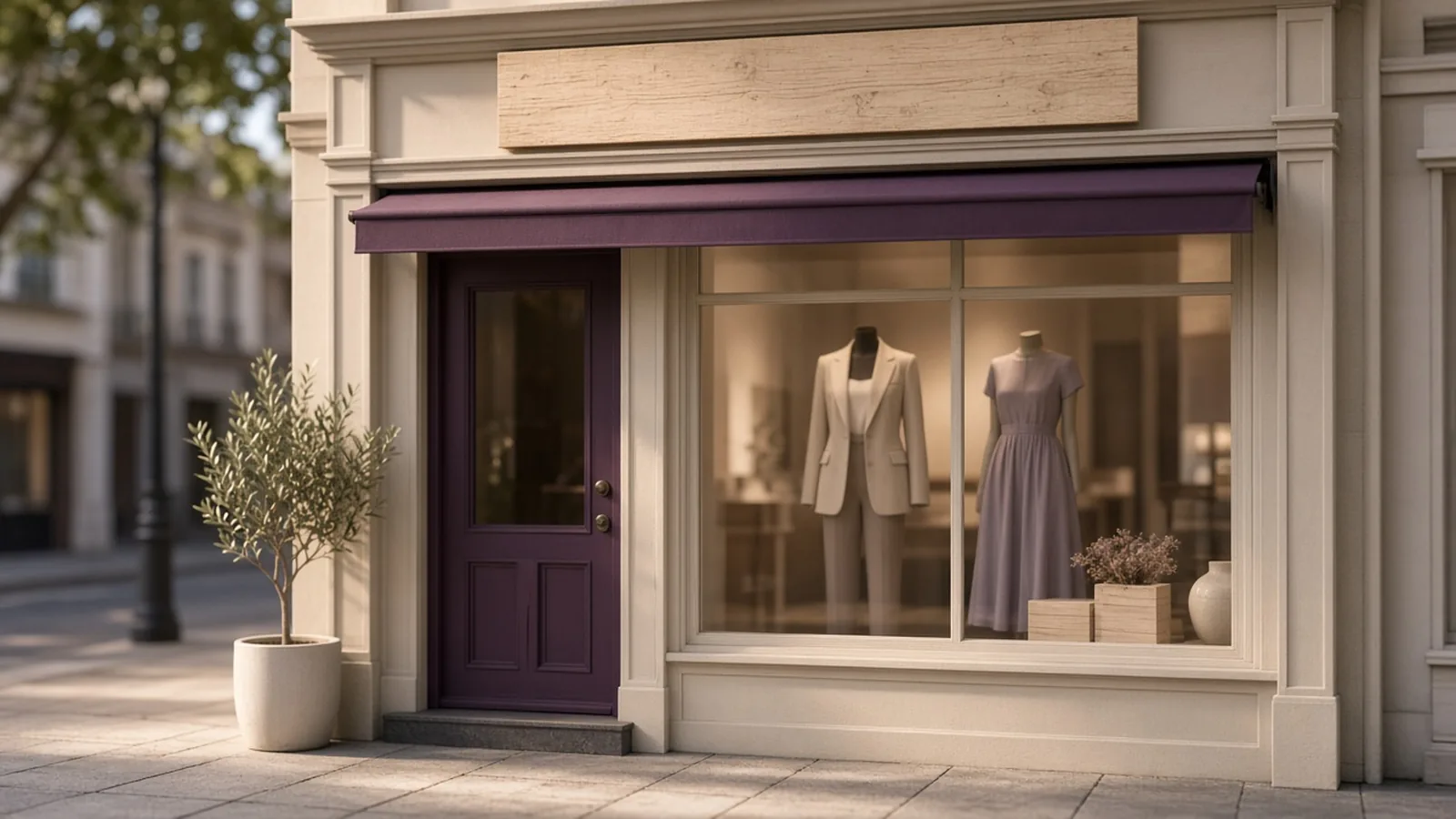
- Measure the sign. A long name means small letters. The image above shows the shape of the problem: a shop sign is a long, narrow strip, and it has to read from across the road.
- Think five years on. Will it still fit if you add menswear, move or take on a partner? Business Wales also warns against words that date quickly.
- Check it in other languages. If your customers speak more than one, ask someone fluent how it sounds and what it means. Business Wales gives the same advice for trading abroad. Check any spelling in another script too, so the name reads properly on an Arabic, Devanagari or Cyrillic sign.
- Ask strangers. Family will be kind. Ask a few people who do not know you what kind of shop they would expect.
Check that it is free to use
Work through these in order. Each check costs little or nothing, and a sign, labels and a website cost much more.
1. A plain search
Search the name with your city and with words like tailor. Look through maps, directories and social media. A similar shop in your area is reason enough to drop it.
2. The business register
Each country has its own rules, so ask your national business registry. UK rules show the kind of thing to expect. On GOV.UK, a company cannot register a name that is the same as an existing one, and it may have to change a name that is too like an earlier one. Some sensitive words need permission. Sole traders cannot use words like "Ltd", and their paperwork must show their own name as well as any business name.
3. Trade marks
This is the check many people skip, and it can force a rebrand after you have paid for everything. GOV.UK warns that a name too similar to someone's trade mark may have to change after a complaint.
WIPO's Global Brand Database lets you search trade marks registered around the world, by name or image. WIPO warns that results may be incomplete for some countries, and suggests asking local IP offices. So search your own national trade mark office too. Look for similar spellings and sounds, not just exact matches. If the name matters to you, pay a trade mark adviser to check it.
4. Domain and social handles
Check that you can get a web address and handles close to the name. If the exact one has gone, adding "tailors" or your city usually works. Avoid a hyphen or odd spelling that you would have to explain out loud.
Registering is one step, protecting is another
Getting a company name or web address can feel like owning the name. It may not be. The law firm Mathys & Squire says that registering and using a domain name does not provide trade mark protection, and calls the same belief about company names a common misconception. If you plan to grow, ask your national trade mark office how to apply to register yours, or take advice.
Business Wales also suggests keeping a plain company name and a more creative trading name, which leaves you room to add other brands later.
Then put the name to work
Once it is settled, use it the same way everywhere: sign, cards, labels, tickets and invoices. Our invoice template is an easy place to start, and our step-by-step guide covers what comes next. When the work behind the name grows, Tailoq is tailoring software for businesses that make for stock, make for a customer and sell both.