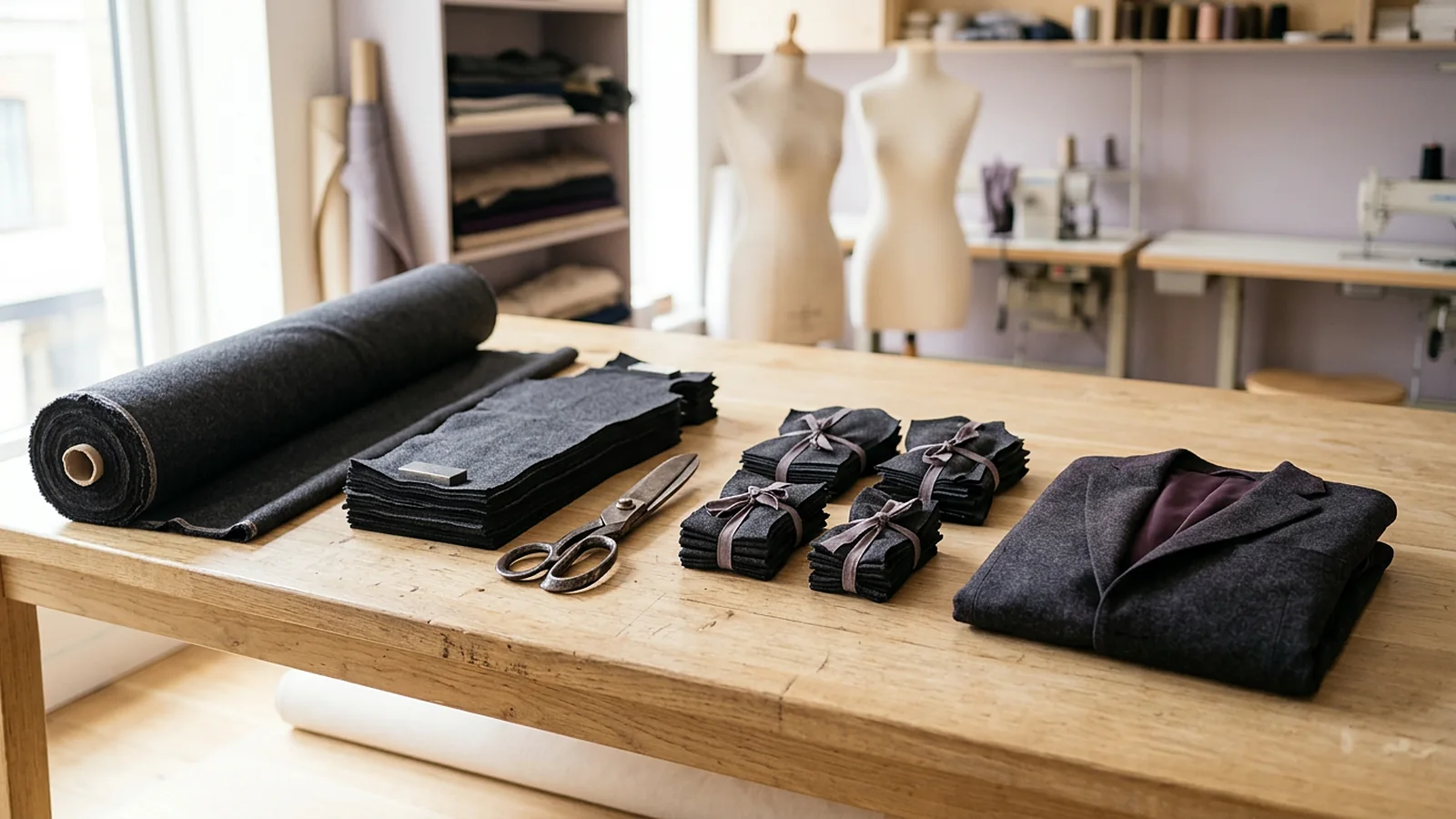
School uniform breaks the usual rhythm of a workshop. You cut in the quiet months and sell in a rush just before term. If you guess the sizes wrong, you find out when parents are at the counter and there is no time left to make more.
The lead times are long. UK government guidance for schools says suppliers typically schedule production 9 to 12 months ahead, and tend to order branded stock by December for delivery by June or July. Your term dates and customers will differ, but the shape of the problem is the same in most places: work backwards from the first day of term.
Build a calendar from the first day of term
Take each school's start date and count back. Set a date to confirm the order, a date to buy cloth, a date to cut and a date to have stock on the shelf. Allow for embroidery if it goes outside, because every other uniform maker's embroiderer is busy at the same time as yours.
Then build in your own capacity. Example only: a workshop can finish 60 shirts a day, and it needs 3,000 shirts across all schools. That is 50 working days, which is ten weeks at five days a week. Add jackets, skirts and repeat orders, and you can see why the start date falls so early.
Plan size runs from last year's sales
A school uniform order is a size curve. Children grow, so a small error at one end of the range leaves you with shelves of one size and none of the next.
Start with what sold last year, by size and by school. Add a cover for growth and late joiners. Keep that cover modest, because unsold stock with a crest on it has one buyer.
| Size (example shirt) | Sold last year | Plus 10% |
|---|---|---|
| Age 5 to 6 | 40 | 44 |
| Age 7 to 8 | 60 | 66 |
| Age 9 to 10 | 70 | 77 |
| Age 11 to 12 | 50 | 55 |
| Age 13 | 30 | 33 |
| Total | 250 | 275 |
Now check the cloth. At an example average of 1.2 metres a shirt, 275 shirts need 330 metres. Larger sizes use more than smaller ones, so work it out by size if you can. Do the sum before you cut, and buy from one dye lot where possible. Navy from two lots can show up plainly when two children stand side by side.
Hold stock school by school
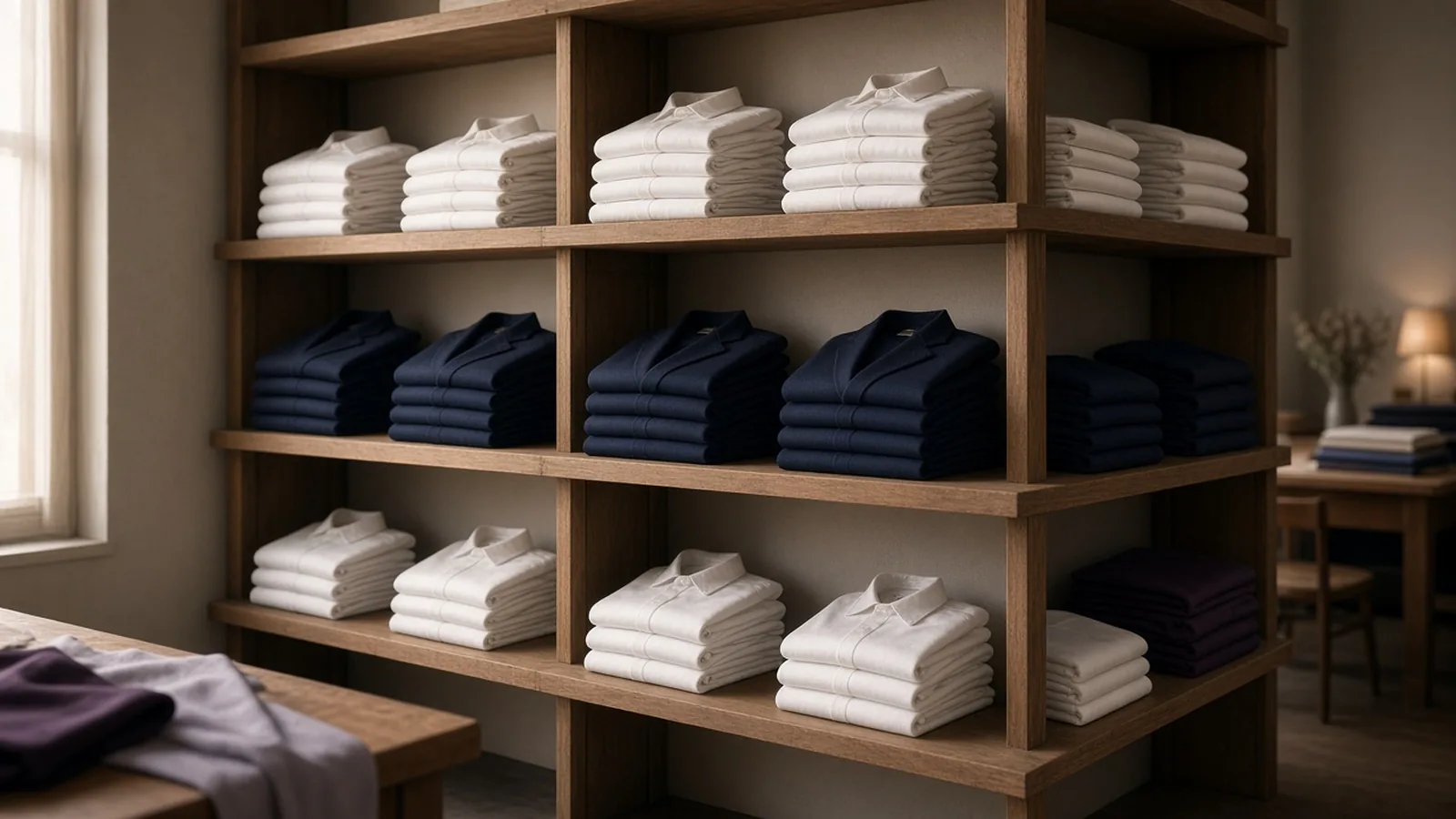
A plain white shirt fits any school. A crested jacket fits one. Sort your stock that way.
- Generic items such as plain shirts, grey trousers and skirts can be held as one stock and shared.
- Branded items carry a crest, a colour or a stripe unique to one school. Count them by school and by size.
- Blanks are garments made up and held without the badge. Sew on the crest when you know which school needs it.
Blanks are worth a close look. A blank jacket can go to any school that uses the same colour, so you take on less risk than with crested stock. The UK guidance also points schools towards cheaper branding, saying this "may involve using sew-on or iron-on labels". A sew-on label also lets you finish late, once you can see the real demand.
Watch for policy changes
A school that changes its colour or crest can leave you with old stock. Ask about changes before you cut, and get them in writing. The rules for schools matter as well. In England, the guidance says schools must limit compulsory branded items to 3 or fewer from September 2026, or 4 or fewer if one is a tie for secondary and middle schools. A school that cuts its branded list will buy fewer crested pieces from you, so read that into next year's plan.
The same guidance says schools should avoid single-supplier contracts unless regular tendering competitions are run, with a re-tender at least every five years, and should have a written contract for branded items. Outside England, check with the school and the education authority that applies.
Invoicing a school is a different job from selling to a parent
Parents pay at the counter. A school or a company buying staff uniforms usually wants a quote, a purchase order reference and an invoice on terms. Keep these sales apart, so you can see what you are owed and when. Ask early who approves the invoice, because term-time payment can be slow.
In the UAE there is a further point. UAE businesses move in phases, starting in 2027, to structured eInvoices for their sales to other businesses and government bodies. These travel through an Accredited Service Provider (ASP) accredited by the Ministry of Finance. A PDF or a scanned invoice is not an eInvoice. Sales to individual customers are currently outside the system, but a business that also sells to companies or government bodies is subject to it, whether or not it is VAT registered. If your revenue is below AED 50 million, the last date to appoint an ASP is 31 March 2027, and the last date to go live is 1 July 2027. Tailoq is not an ASP. We checked this against Ministry of Finance publications on 3 November 2026. It is not tax or legal advice, so look at the Ministry's portal or ask your tax adviser.
What to ask of software
- Can one batch hold pieces per size, and show the material needed before you cut?
- Can a batch be split when part of it goes out for embroidery?
- If 200 go out and 197 come back, is the shortfall recorded?
- Do finished batches enter stock by size?
- Can I see the cost per piece, so that the price quoted to a school can be tested?
Tailoq has a Uniforms preset that runs Order placed, Sizing, Cutting, Stitching, Logo embroidery, Packing, Ready, and it handles batches by size and the send-out to an embroiderer. See how this works for uniform and garment workshops. Two cautions apply. Its reorder suggestions look at 30 days of sales, so plan a seasonal peak from last year's records. It also does not raise invoices for school accounts today. For more on setting up the floor, read how to track garment production.
See how Tailoq tracks a uniform batch by size from cutting to finished stock.
Garment workshops Book a demo